An Illustratedhistory of the Uniforms of the Roman Review
A State of war Diary Soars Over Rome
The story of Emperor Trajan's victory over a mighty barbarian empire isn't just one for the books. Information technology'south also told in 155 scenes carved in a spiral frieze on a monumental cavalcade.

Trajan'southward Column, with a statue of St. Peter installed by a Renaissance pope on top, towers over the ruins of Trajan's Forum, which once included two libraries and a g civic space paid for by war spoils from Dacia. The massive mod monument at right commemorates Victor Emmanuel Ii, the first king of a united Italy.
Story by Andrew Back-scratch
Photographs past Kenneth Garrett
In back-to-dorsum wars fought between A.D. 101 and 106, the emperor Trajan mustered tens of thousands of Roman troops, crossed the Danube River on two of the longest bridges the ancient world had always seen, defeated a mighty barbarian empire on its mountainous home turf twice, then systematically wiped it from the face of Europe.
Trajan's war on the Dacians, a civilization in what is now Romania, was the defining event of his 19-year dominion. The boodle he brought back was staggering. One contemporary chronicler boasted that the conquest yielded a half million pounds of gilt and a million pounds of argent, not to mention a fertile new province.
The booty changed the landscape of Rome. To commemorate the victory, Trajan deputed a forum that included a spacious plaza surrounded by colonnades, two libraries, a grand civic space known as the Basilica Ulpia, and possibly even a temple. The forum was "unique under the heavens," one early on historian enthused, "beggaring description and never once again to be imitated by mortal men."
Towering over it was a stone column 126 anxiety loftier, crowned with a bronze statue of the conqueror. Spiraling around the column like a mod-solar day comic strip is a narrative of the Dacian campaigns: Thousands of intricately carved Romans and Dacians march, build, fight, sail, sneak, negotiate, plead, and perish in 155 scenes. Completed in 113, the column has stood for more than than one,900 years.

Trajan, who ruled from A.D. 98 until 117, when he fell sick and died, expanded the Roman Empire to its farthest boundaries. In this marble statue he wears armor typically used in triumphal parades.
Today tourists crane their necks upward at it equally guides explicate its history. The eroded carvings are hard to brand out above the starting time few twists of the story. All around are ruins—empty pedestals, cracked flagstones, cleaved pillars, and shattered sculptures hint at the magnificence of Trajan's Forum, at present fenced off and closed to the public, a testament to past majestic glory.
The cavalcade is ane of the most distinctive awe-inspiring sculptures to have survived the autumn of Rome. For centuries classicists have treated the carvings as a visual history of the wars, with Trajan as the hero and Decebalus, the Dacian king, as his worthy opponent. Archaeologists have scrutinized the scenes to learn about the uniforms, weapons, equipment, and tactics the Roman Ground forces used.
And because Trajan left Dacia in ruins, the column and the remaining sculptures of defeated soldiers that once decorated the forum are treasured today by Romanians as clues to how their Dacian ancestors may have looked and dressed.
The column was deeply influential, the inspiration for later monuments in Rome and across the empire. Over the centuries, as the city's landmarks crumbled, the column continued to fascinate and awe. A Renaissance pope replaced the statue of Trajan with one of St. Peter, to sanctify the aboriginal artifact. Artists lowered themselves in baskets from the top to study it in item. Later it was a favorite attraction for tourists: Goethe, the German language poet, climbed the 185 internal steps in 1787 to "bask that incomparable view." Plaster casts of the column were fabricated starting in the 1500s, and they have preserved details that acid pelting and pollution accept worn away.
Debate still simmers over the column's construction, meaning, and most of all, historical accurateness. It sometimes seems as if there are as many interpretations equally there are carved figures, and there are 2,662 of those.
Travel in time with this end-motion animation and see how Trajan's Column was built—according to one theory. How it was made and how accurate it is remain the subjects of spirited debate.
Filippo Coarelli, a ladylike Italian archaeologist and art historian in his late 70s, literally wrote the book on the subject. In his dominicus-flooded living room in Rome, he pulls his illustrated history of the column off a crowded bookshelf. "The column is an amazing piece of work," he says, leafing through black-and-white photos of the carvings, pausing to admire dramatic scenes. "The Dacian women torturing Roman soldiers? The weeping Dacians poisoning themselves to avoid capture? It'south like a TV series."
Or, Coarelli says, like Trajan's memoirs. When information technology was built, the column stood betwixt the two libraries, which possibly held the soldier-emperor'southward business relationship of the wars. The way Coarelli sees information technology, the etching resembles a scroll, the likely course of Trajan's war diary. "The artist—and artists at this time didn't have the freedom to do what they wanted—must have acted according to Trajan's will," he says.
Working under the supervision of a maestro, Coarelli says, sculptors followed a plan to create a skyscraping version of Trajan'due south scroll on 17 drums of the finest Carrara marble.
The emperor is the story's hero. He appears 58 times, depicted as a canny commander, achieved statesman, and pious ruler. Hither he is giving a speech to the troops; in that location he is thoughtfully conferring with his directorate; over there, presiding over a sacrifice to the gods. "Information technology'due south Trajan's attempt to be non only a man of the army," Coarelli says, "but as well a homo of culture."
Of grade Coarelli's speculating. Whatever course they took, Trajan's memoirs are long gone. In fact clues gleaned from the column and excavations at Sarmizegetusa, the Dacian capital, suggest that the carvings say more than about Roman preoccupations than about history.
Jon Coulston, an expert on Roman iconography, arms, and equipment at the University of St. Andrews in Scotland, studied the cavalcade up shut for months from the scaffolding that surrounded information technology during restoration piece of work in the 1980s and '90s. He wrote his doctoral dissertation on the landmark and has remained obsessed—and pugnaciously contrarian—always since. "People desperately want to compare it to news media and films," he says. "They're overinterpreting and ever have. It's all generic. You can't believe a discussion of information technology."
Coulston argues that no unmarried mastermind was behind the carvings. Slight differences in way and obvious mistakes, such as windows that disrupt scenes and scenes of inconsistent heights, convinced him that sculptors created the column on the fly, relying on what they'd heard virtually the wars. "Instead of having what art historians love, which is a peachy chief and creative mind," he says, "the composition is existence done by grunts at the stone face, non on a drawing board in the studio."
The artwork, in his view, was more "inspired by" than "based on." Accept the column's priorities. There's not much fighting in its depiction of the two wars. Less than a quarter of the frieze shows battles or sieges, and Trajan himself is never shown in combat.
Meanwhile legionaries—the highly trained backbone of Rome's war motorcar—occupy themselves with building forts and bridges, immigration roads, even harvesting crops. The column portrays them as a forcefulness of society and civilization, not destruction and conquest. You'd think they were invincible too, since there's not a single expressionless Roman soldier on the column.

Trajan's Dacian Wars
From their powerful realm north of the Danube River, the Dacians regularly raided the Roman Empire. In A.D. 101 Trajan fortified the border and invaded with tens of thousands of troops. Two years of state of war led to a negotiated peace, which the Dacians promptly bankrupt. Trajan returned in 105 and crushed them.


The column emphasizes Rome's vast empire. Trajan'southward army includes African cavalrymen with dreadlocks, Iberians slinging stones, Levantine archers wearing pointy helmets, and blank-chested Germans in pants, which would have appeared exotic to toga-clad Romans. They're all fighting the Dacians, suggesting that anyone, no matter how wild their hair or crazy their fashion sense, could become a Roman. (Trajan was born to Roman parents in what is now Spain.)
Some scenes remain ambiguous and their interpretations controversial. Are the besieged Dacians reaching for a cup to commit suicide past drinking poison rather than face humiliation at the hands of the acquisition Romans? Or are they just thirsty? Are the Dacian nobles gathered around Trajan in scene after scene surrendering or negotiating?
And what nearly the shocking depiction of women torturing shirtless, leap captives with flaming torches? Italians see them every bit convict Romans suffering at the easily of barbarian women. Ernest Oberländer-Târnoveanu, the caput of the National History Museum of Romania, begs to differ: "They're definitely Dacian prisoners existence tortured by the aroused widows of slain Roman soldiers." Like much about the cavalcade, what you see tends to depend on what you lot call up of the Romans and the Dacians.
Amongst Roman politicians, "Dacian" was synonymous with double-dealing. The historian Tacitus called them "a people which never can be trusted." They were known for squeezing the equivalent of protection money out of the Roman Empire while sending warriors to raid its borderland towns. In 101 Trajan moved to punish the troublesome Dacians. Afterwards nearly 2 years of battle Decebalus, the Dacian king, negotiated a treaty with Trajan, then promptly broke information technology.
Rome had been betrayed in one case as well many. During the second invasion Trajan didn't mess effectually. Merely await at the scenes that show the looting of Sarmizegetusa or villages in flames.
"The campaigns were dreadful and violent," says Roberto Meneghini, the Italian archaeologist in charge of excavating Trajan'southward Forum. "Look at the Romans fighting with cutoff heads in their mouths. War is war. The Roman legions were known to exist quite fierce and vehement."
Yet in one case the Dacians were vanquished, they became a favorite theme for Roman sculptors. Trajan'south Forum had dozens of statues of handsome, bearded Dacian warriors, a proud marble army in the very center of Rome.
The message seems intended for Romans, not the surviving Dacians, nearly of whom had been sold as slaves. "No Dacians were able to come and come across the column," Meneghini says. "It was for Roman citizens, to testify the power of the majestic machinery, capable of acquisition such a noble and violent people."
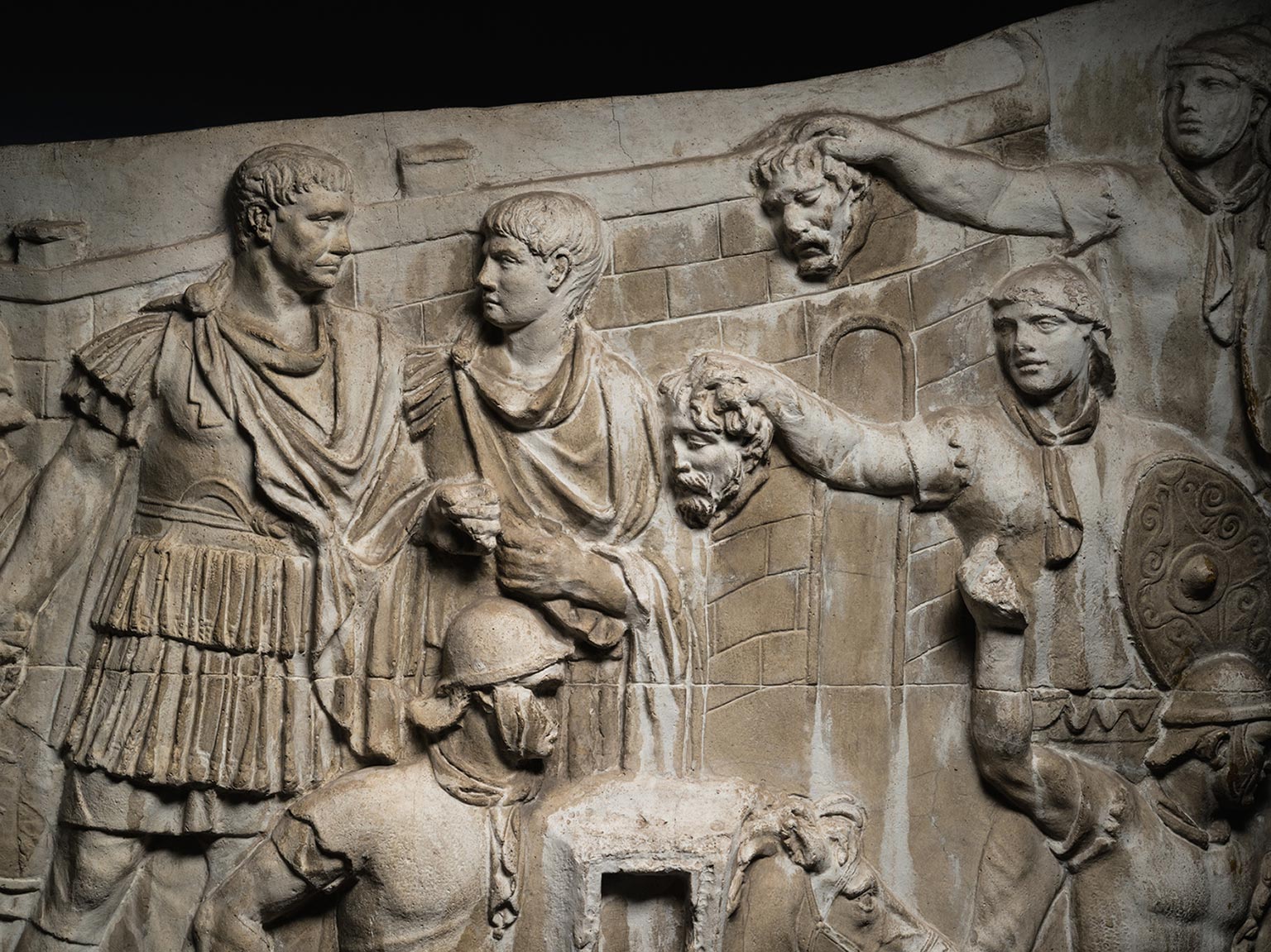
In a visual narrative that winds from the cavalcade's base of operations to its top, Trajan and his soldiers triumph over the Dacians. In this scene from a plaster and marble-dust cast fabricated between 1939 and 1943, Trajan (at far left) watches a battle, while two Roman auxiliaries nowadays him with severed enemy heads.
Trajan's Column may be propaganda, but archaeologists say in that location'due south an chemical element of truth to it. Excavations at Dacian sites, including Sarmizegetusa, continue to reveal traces of a culture far more sophisticated than unsaid by "barbarian," the dismissive term the Romans used.
The Dacians had no written language, so what we know about their civilisation is filtered through Roman sources. Ample bear witness suggests that they were a regional power for centuries, raiding and exacting tribute from their neighbors. They were skilled metalworkers, mining and smelting iron and panning for golden to create magnificently ornamented jewelry and weaponry.
Sarmizegetusa was their political and spiritual capital. The ruined metropolis lies loftier in the mountains of central Romania. In Trajan's 24-hour interval the thousand-mile journey from Rome would have taken a month at least. To get to the site today, visitors have to negotiate a potholed dirt road through the aforementioned forbidding valley that Trajan faced. Back then the passes were guarded past elaborate ridgetop fortifications; now merely a few peasant huts keep watch.
The towering beech trees that have grown thick over Sarmizegetusa blot out the dominicus, casting a chill shade fifty-fifty on a warm day. A broad flagstone road leads from the thick, half-cached walls of a fortress down to a broad, flat meadow.
This green area—a terrace carved out of the mountainside—was the religious centre of the Dacian world. Traces of buildings remain, a mix of original stones and concrete reproductions, the legacy of an aborted communist-era attempt to reconstruct the site. A triple ring of stone pillars outlines a one time impressive temple that distantly echoes the circular Dacian buildings on Trajan'south Column. Next to information technology is a low, circular stone altar carved with a sunburst design, the sacred middle of the Dacian universe.

This scene shows Roman soldiers loading plunder onto pack animals after defeating Decebalus, the Dacian king. Casts such as this 1 preserve details on Trajan's Column that pollution has eroded.


Reading an Ancient Comic Strip
Explore Trajan's Column in an interactive graphic.
For the past 6 years Gelu Florea, an archaeologist from Babeș-Bolyai University in Cluj-Napoca, has spent summers excavating the site. The exposed ruins, along with artifacts recovered from looters, reveal a thriving hub of manufacturing and religious ritual. Florea and his team have found prove of Roman military know-how and Greek architectural and artistic influences. Using aeriform imaging, archaeologists accept identified more than 260 man-fabricated terraces, which stretch for nearly 3 miles forth the valley. The entire settlement covered more than than 700 acres. "It's astonishing to encounter how cosmopolitan they were up in the mountains," says Florea. "It'southward the biggest, most representative, about complex settlement in Dacia."
There is no sign that the Dacians grew food up here. There are no cultivated fields. Instead archaeologists accept establish the remains of dumbo clusters of workshops and houses, along with furnaces for refining iron ore, tons of iron hunks ready for working, and dozens of anvils. It seems the metropolis was a center of metal product, supplying other Dacians with weapons and tools in exchange for gilt and grain.
The site is lush and placidity. Not far from the altar rises a small spring that could have provided water for religious rituals. Flecks of natural mica make the dirt paths sparkle in the sun. The few tourists speak in hushed voices.
It's hard to imagine the ceremonies that took place here—and the terrible stop. As Florea conjures the smoke and screams, looting and slaughter, suicides and panic depicted on Trajan'southward Column, there'southward a rumble of thunder. The sky is all of a sudden menacing, the air sticky and humid.
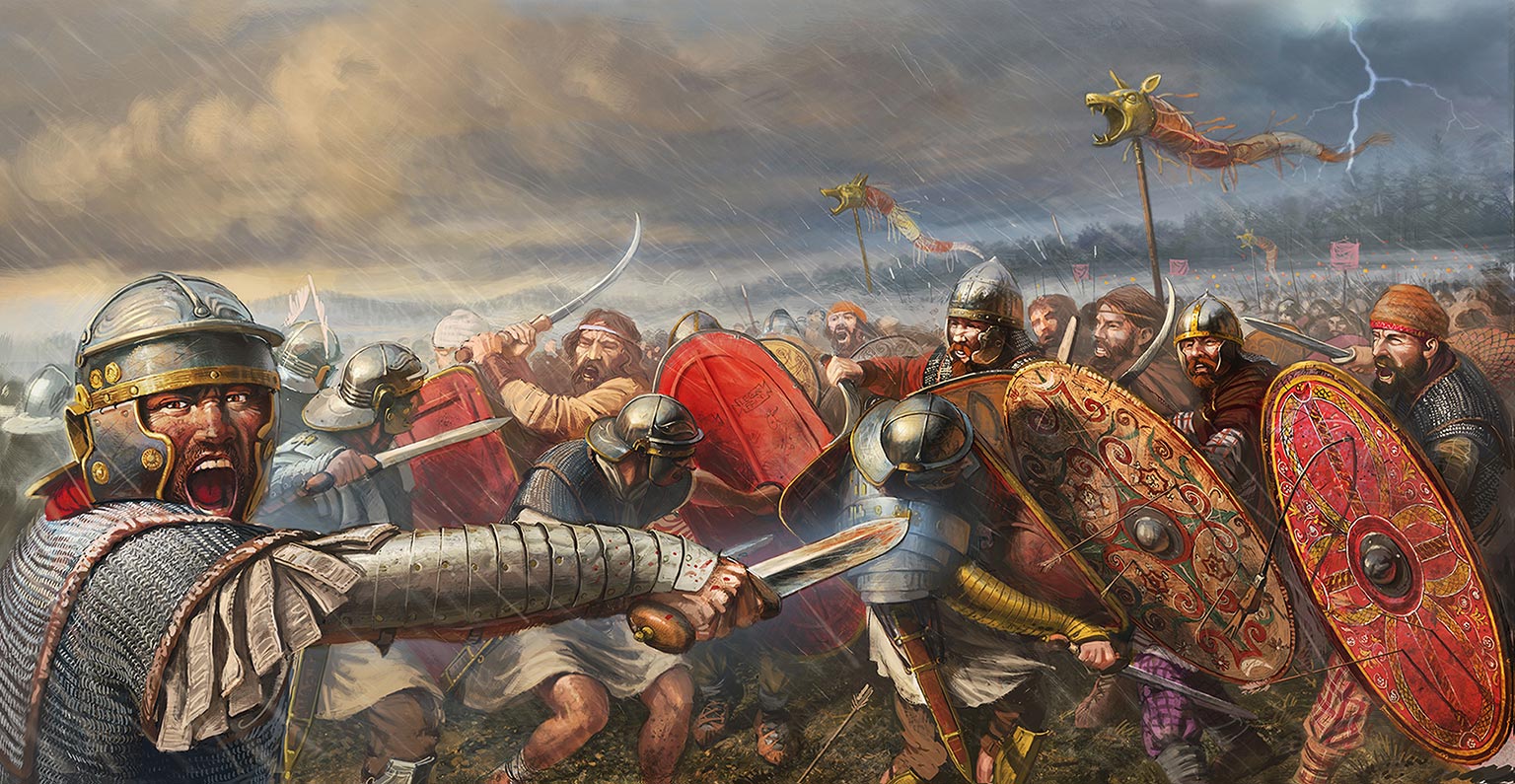
In the offset major boxing Trajan defeated the Dacians (background) at Tapae. A tempest indicated to the Romans (foreground) that the god Jupiter, with his thunderbolts, was on their side.


Dacians fashioned precious metals into jewelry, coins, and art, such equally the gold-trimmed silverish drinking vessel at left. These gilded coins with Roman imagery and bracelets weighing up to two pounds each were looted from the ruins of Sarmizegetusa, the Dacian capital letter, and recovered in recent years.
The destruction of Dacia's holiest temples and altars followed Sarmizegetusa's fall. "Everything was dismantled past the Romans," Florea says. "There wasn't a building remaining in the entire fortress. It was a show of power—we have the ways, nosotros have the power, nosotros are the bosses."
The residue of Dacia was devastated too. About the top of the column is a glimpse of the denouement: a village put to the torch, Dacians fleeing, a province empty of all just cows and goats.
The ii wars must have killed tens of thousands. A contemporary claimed that Trajan took 500,000 prisoners, bringing some 10,000 to Rome to fight in the gladiatorial games that were staged for 123 days in celebration.
Dacia'due south proud ruler spared himself the humiliation of surrender. His finish is carved on his archrival's column. Kneeling under an oak tree, he raises a long, curved knife to his ain neck.
"Decebalus, when his majuscule and all his territory had been occupied and he was himself in danger of being captured, committed suicide; and his caput was brought to Rome," the Roman historian Cassius Dio wrote a century later. "In this manner Dacia became subject to the Romans."

A partially reconstructed temple stands near a circular altar in the sacred precinct of Sarmizegetusa, which was demolished after Rome's victory. Trajan colonized his newest province with Roman war veterans, a legacy reflected in the country'southward modern name, Romania.
Andrew Back-scratch wrote about the Roman frontier in the September 2012 upshot. Lensman Kenneth Garrett is a frequent contributor to the magazine.


Backside the Scenes
Run across National Geographic'due south artist-in-residence, Fernando Baptista, to see how the video was made.
Source: https://www.nationalgeographic.com/trajan-column/article.html
0 Response to "An Illustratedhistory of the Uniforms of the Roman Review"
Enregistrer un commentaire